




Facial Orthopedics with Skeletal Anchorage

 Views: 3123
 Times: 98 mins
About the Speakers

Director of the Dental Section, Bauru Craniofacial Center
Dr. Garib has held several leadership roles at the University of São Paulo, including Chair of the Graduate Committee at HRAC-USP, Coordinator of the Graduate Program in Rehabilitation Sciences, and Coordinator of the Evaluation Chamber of the USP Postgraduate Council. She served as President of the Bauruense Foundation for Dental Studies (FUNBEO) from 2019 to 2023.
She is a member of the North Atlantic Angle Society, USA, and serves as an Associate Editor of Orthodontics and Craniofacial Research, Seminars in Orthodontics, and the European Journal of Orthodontics. Her research focuses on cleft lip and palate and craniofacial anomalies, early orthodontic treatment, three-dimensional digital imaging, facial orthopedics, dental anomalies, and the interface between orthodontics and periodontics.

Guest Expert
He completed his dental education and orthodontic training at Universidad Nacional Mayor de San Marcos in Lima, Peru. He also graduated from Bauru Dental School, University of São Paulo in Brazil, where he acquired his Master’s degree and PhD in collaboration with the University of Michigan. His research focuses on treatment outcomes, advanced 3D imaging evaluations, and 3D printing.

Guest Expert
Specialty, master’s, and doctoral degrees in Orthodontics, with an international research fellowship at the University of Michigan and postdoctoral training at Fluminense Federal University.

Speaker
She completed postdoctoral fellowships at the Department of Orthodontics, Bauru Dental School, University of São Paulo, and at the School of Dentistry, University of Michigan. She is currently an Assistant Professor in the Department of Orthodontics at Bauru Dental School, University of São Paulo. Her research focuses on imaging analysis, artificial intelligence applications, cleft lip and palate, orthopedic treatment of Class III malocclusion, and the aging of normal occlusion.

He is currently a PhD candidate also in the Department of Orthodontics of Bauru Dental School, where he is developing his thesis with research fellowships at the University of Michigan School of Dentistry and the UNC Adams School of Dentistry. His research focuses on three-dimensional imaging analysis, artificial intelligence applications, and rapid maxillary expansion protocols.
About this Course
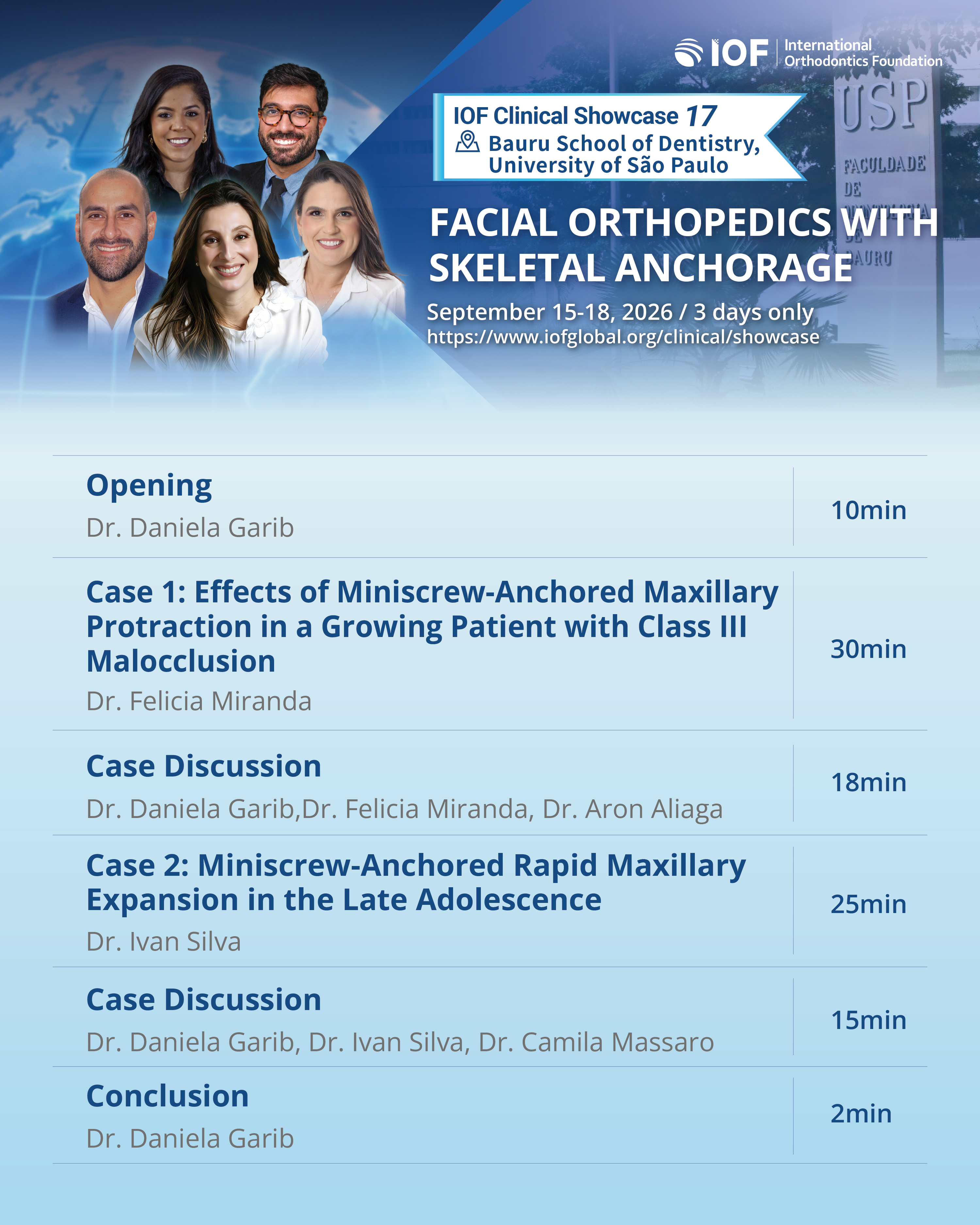
This course offers an in-depth exploration of contemporary orthodontic orthopedics, with a focus on skeletal anchorage for treating growing patients with severe transverse and sagittal discrepancies. Through two carefully documented clinical cases, the program demonstrates maxillary protraction and rapid maxillary expansion in growing patients, highlighting key treatment strategies, clinical decision-making, and long-term outcomes.
The first part of the program focuses on sagittal correction through maxillary protraction, presenting the treatment of an adolescent Class III patient using a miniscrew-anchored maxillary protraction (MAMP) protocol. You will learn how a hybrid expander combined with mini‑screws and Class III elastics can achieve significant midface advancement, correct anterior crossbite, and produce favorable skeletal changes—even in patients beyond the ideal age for facemask therapy.
The second part shifts to transverse correction through rapid maxillary expansion, showcasing the management of a 15‑year‑old patient with bilateral posterior crossbite using a hybrid Hyrax expander with two palatal mini‑screws. You will learn how bone‑borne expanders minimize unwanted dental side effects, maximize skeletal effects, and provide a less invasive alternative to tooth‑borne devices in late adolescence.
What will you learn?
· In treating growing Class III patients with maxillary deficiency, how does miniscrew-anchored maxillary protraction (MAMP) compare to facemask therapy and BAMP? What are the key indications and age‑related considerations?
· For adolescent patients requiring rapid maxillary expansion, what are the advantages of bone‑borne hybrid expanders over conventional tooth‑borne expanders in terms of skeletal effects, dental side effects, and periodontal health?
· How can 3D assessment using CBCT superimposition quantify the three‑dimensional skeletal and dental displacements following maxillary protraction and rapid maxillary expansion?
· What are the critical factors influencing long‑term stability after orthopedic treatment in growing patients, particularly regarding residual mandibular growth, patient compliance, and retention protocols?
· How do clinical variables—such as growth stage, dental development, Wits appraisal, and facial growth pattern—guide patient selection for bone‑anchored orthopedic therapies?
Schedule
 Course Details
Learning & Reflection