




From Childhood Transverse Management to Adult Open Bite Treatment



 Views: 3565
 Times: 115 mins
About the Speakers

Mentor
Head of the Department of Orthodontics at University of Gothenburg, Sweden
Clinically, she works at Mun-H-Center, Sweden’s national resource center for rare diseases, where she provides orthodontic care for patients with complex medical conditions. In addition, she is active in private practice.
Her research is translational and clinically anchored, focusing on biomaterials, bone biology, craniofacial and dentoalveolar growth, tooth eruption, retention, interceptive treatment, and caries research. She is actively involved in national research on genetic susceptibility to caries in orthodontic patients. Her scientific production includes a substantial body of peer-reviewed original research, invited reviews, and book chapters, with sustained citation impact. She has supervised multiple doctoral and master’s projects and continues to mentor the next generation of researchers.
In addition to her academic leadership, she drives quality development of orthodontic care within Sweden’s largest dental organization and contributes to the Swedish National Guidelines for orthodontic treatment.

Guest Expert
He has published over 220 peer-reviewed and is the author of four orthodontic textbooks, including the popular Handbook of Orthodontics, now in its third edition. He was Director of Research at the British Orthodontic Society from 2012-2016 and Editor-in-Chief of the Journal of Orthodontics from 2012-2022. He won the B. F. and Helen E. Dewel Award of the American Association of Orthodontists for the most outstanding clinical research article published in the AJODO in 2019. He will serve as Dean of the Faculty of Dental Surgery at the Royal College of Surgeons of England 2026-2029.

Guest Expert
Professor of Orthodontics and Research Methodology,
the Universidad Complutense of Madrid (UCM)
Faculty of Odontology, Madrid, Spain
- She has been a Clinical Teacher in the Postgraduate Orthodontics Program at UCM since 1996 and holds a Doctorate in Odontology, along with specialized training in Orthodontics and advanced studies at UCLA.
- She co-leads the BIOCRAN research group, officially recognized and funded by the Spanish Government, focusing on craniofacial biology and dentofacial orthopedics.
- Her research spans orthodontics, masticatory muscle physiology, and periodontal therapy, including involvement in multidisciplinary projects on malocclusions and bone and soft tissue biology.

Speaker
In 2008, Dr. Bazargani completed his specialist training in Örebro, Sweden, and became an associate professor in Orthodontics at Malmö University in 2015. He took on the role of Head of Department in Örebro in 2017. Over the next six years, he led the department, focusing on improving patient care and overseeing clinical operations and specialist training programs.
Dr. Bazargani focuses on clinical, patient-centred research and randomized controlled trials concerning impacted canines, rapid maxillary expansion and retention. He promotes collaboration between clinicians, researchers, and public health professionals to improve clinical and patient outcomes. Dr. Bazargani is a three-time award winner for best-published articles.
Since 2023, he has worked as a senior lecturer at the Department of Odontology at the University of Gothenburg and, in August 2024, was appointed Professor of Orthodontics at the University of Gothenburg.

Speaker
In 1999, he defended his PhD thesis on orthodontic treatment and (TMD). He became a member of the Angle Society of Europe in 2002 and served as its President from 2020 to 2023. He has an extensive publication record, and he is a distinguished speaker, both in Sweden and internationally.
About this Course
About this Course
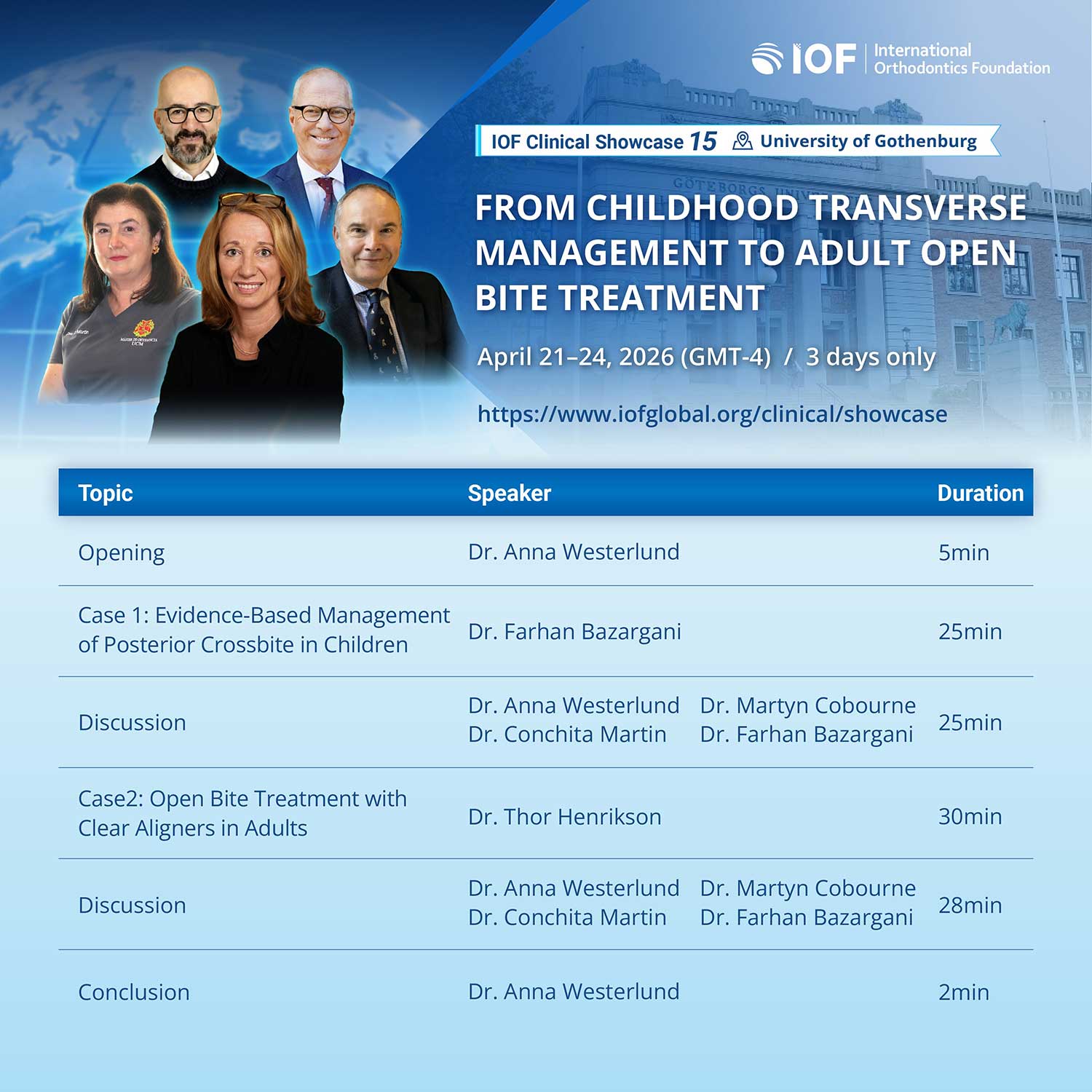
This course provides a comprehensive exploration of contemporary orthodontic treatment strategies, focusing on two critical areas of clinical practice: transverse management and vertical management.
The first part of the program focuses on transverse management, specifically addressing the early interceptive treatment of posterior crossbite in the mixed dentition. You will explore evidence-based comparisons of treatment modalities with a focus on their skeletal and dental effects, patient-reported pain and discomfort, anchorage strategies (including the use of primary teeth and mini-screws), and cost-effectiveness.
The second part shifts to vertical management, concentrating on the comprehensive treatment of open bite malocclusion using clear aligner therapy in adults. You will learn about advanced biomechanical principles, including sequential posterior intrusion, the use of temporary anchorage devices (TADs) to enhance predictability, and strategies for achieving stable, long-term results in challenging vertical problems.
What will you learn?
What are the key clinical and evidence-based considerations when selecting between tooth-borne rapid maxillary expansion (RME) and quad-helix appliances for posterior crossbite in young children?
How do different expansion appliances compare in terms of side-effects, patient-reported discomfort, and cost-effectiveness?
What are the advantages and limitations of clear aligners in treating open-bite malocclusion? How does sequential posterior intrusion protocol improve predictability compared to en-masse intrusion?
What are the essential design principles for achieving true posterior intrusion and a counterclockwise mandibular rotation with clear aligners? What role does temporary anchorage devices (TADs) play?
What factors are critical for long-term stability in open-bite treatment, including retention protocols, relapse risk, and patient-specific factors such as tongue posture and compliance?
Schedule
 Course Details