






Launched in 2022 with a single mission — to identify like-minded explorers and empower researchers committed to advancing orthodontic innovation and clinical translation — the IOF Research Grants program operates on a non-commercial, science-driven ethos. It seeks to break down geographical barriers and foster close collaboration between clinicians and scholars worldwide.
The IOF Research Grants program, has received over 246 applications from 32 countries and regions, funded 56 projects, and contributed to more than 35 peer-reviewed publications in 4 years. By prioritizing innovation with strong clinical relevance, without limitation by geography or academic hierarchy, it has laid a solid foundation for a global research network and a clinically oriented innovation pipeline.
Building a Systematic Innovation Support Framework
In 2025, IOF advanced its evaluation framework along two pillars: a structured translational system and an integrated academia––industry collaboration model. This strategic evolution spans the full innovation lifecycle, from early concept to mature clinical application.
In response to feedback from researchers worldwide, the program has evolved from isolated project funding into a systematic support framework. The goal is not merely to fund innovation, but to ensure that emerging technologies address unresolved clinical challenges — helping each project grow from seedling to maturity.
To support this structure, IOF introduced two dedicated funding tracks: Emerging Innovation Grants (EIG) and Advanced Innovation Grants (AIG).
• EIG offers two categories of one-year seed funding: Early-Stage and Mid-Level grants. These grants prioritize innovation and real-world impact over academic credentials and are open to orthodontists, researchers, engineers, and other medical professionals.
• AIG supports projects beyond early stages, enabling larger-scale applications and multicenter research. It funds research with strong potential for implementation and real-world impact.
The 2025 cycle received 40 applications. Following rigorous review, the funded projects span key areas including Artificial Intelligence (AI) and digital orthodontics, biomechanics and clinical protocols, craniofacial biology and tissue engineering, biomaterials and preventive solutions, as well as patient-centered research. The cohort brings together established academic leaders, experienced clinical investigators and emerging interdisciplinary innovators.
2025 Award List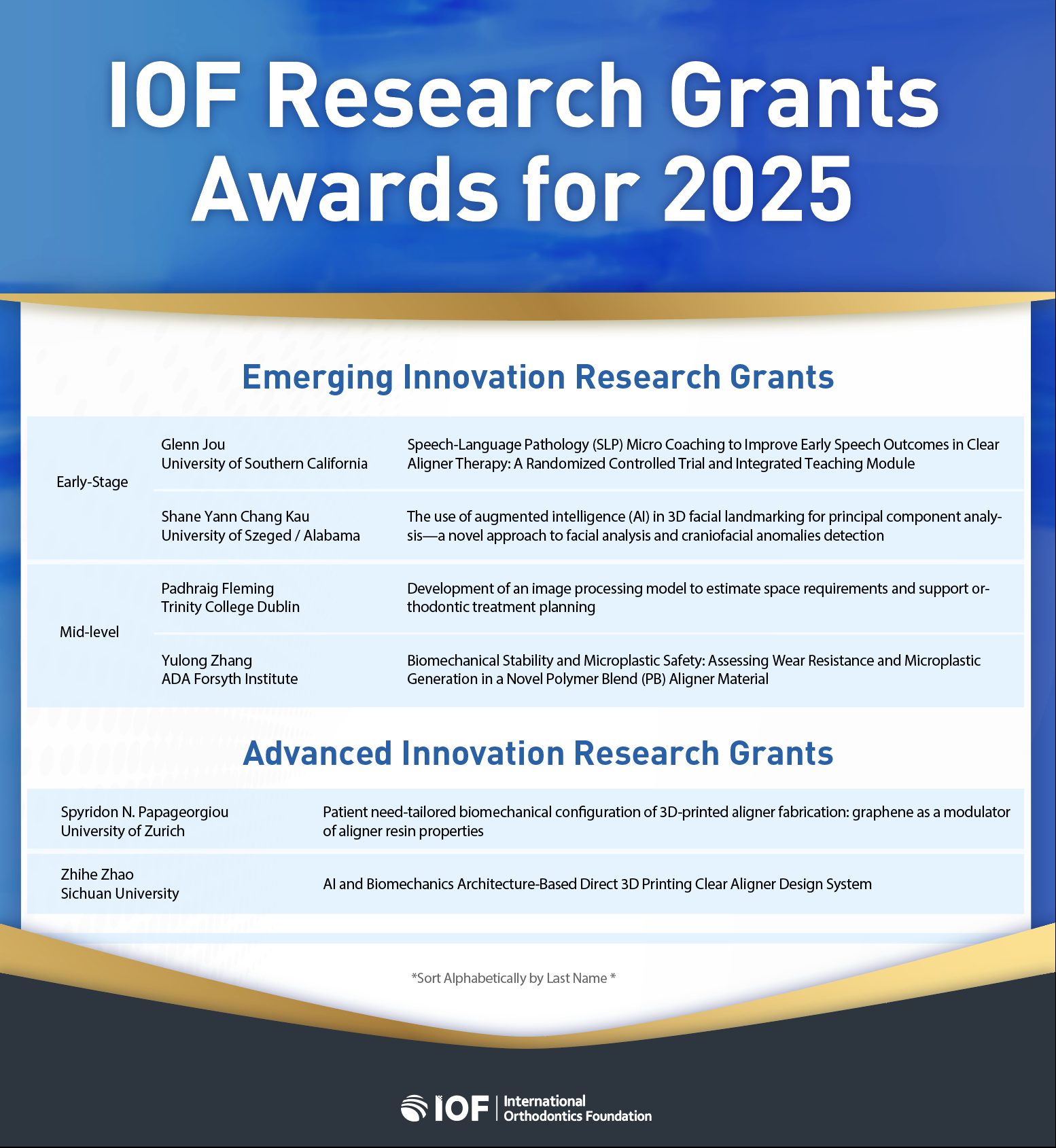
Overall, the 2025 award list reveals three trends:
• AI and digital technologies now sit at the core of orthodontic research.
• Clinical translation remains the driving priority, with projects anchored in evidence-based practice.
• The cohort reflects growing cross-disciplinary and global collaboration.
Together, EIG and AIG form an integrated pipeline: one nurtures early-stage exploration, the other accelerates mature research toward clinical application. This dual-track system balances support for emerging talent with pathways for established teams to bring findings into practice.
The 2026 Cycle: Nurturing the Next Generation
The IOF Research Grants program is a global funding initiative dedicated to advancing scientific and technological innovation in orthodontics and related fields. Applications are reviewed by members of the IOF Science Committee in accordance with international standards for orthodontic research funding. Beyond financial support, the IOF Science Committee provides expert review and strategic guidance to help researchers refine and deepen their work. To accelerate real-world impact, IOF also serves as a bridge connecting researchers with clinicians and industry partners, validating and fast-tracking the practical application of promising discoveries.
Building on the milestones of 2025, IOF will continue refining and expanding its funding framework in 2026, with a stronger focus on clinical evidence generation, interdisciplinary and cross-regional collaboration, and enhanced academia--industry linkages to further accelerate orthodontic innovation.
As the field of orthodontics continues to evolve through advances in AI, digital technologies, biomaterials, and multidisciplinary care, IOF remains committed to supporting emerging researchers and accelerating the translation of their discoveries into clinical practice.